
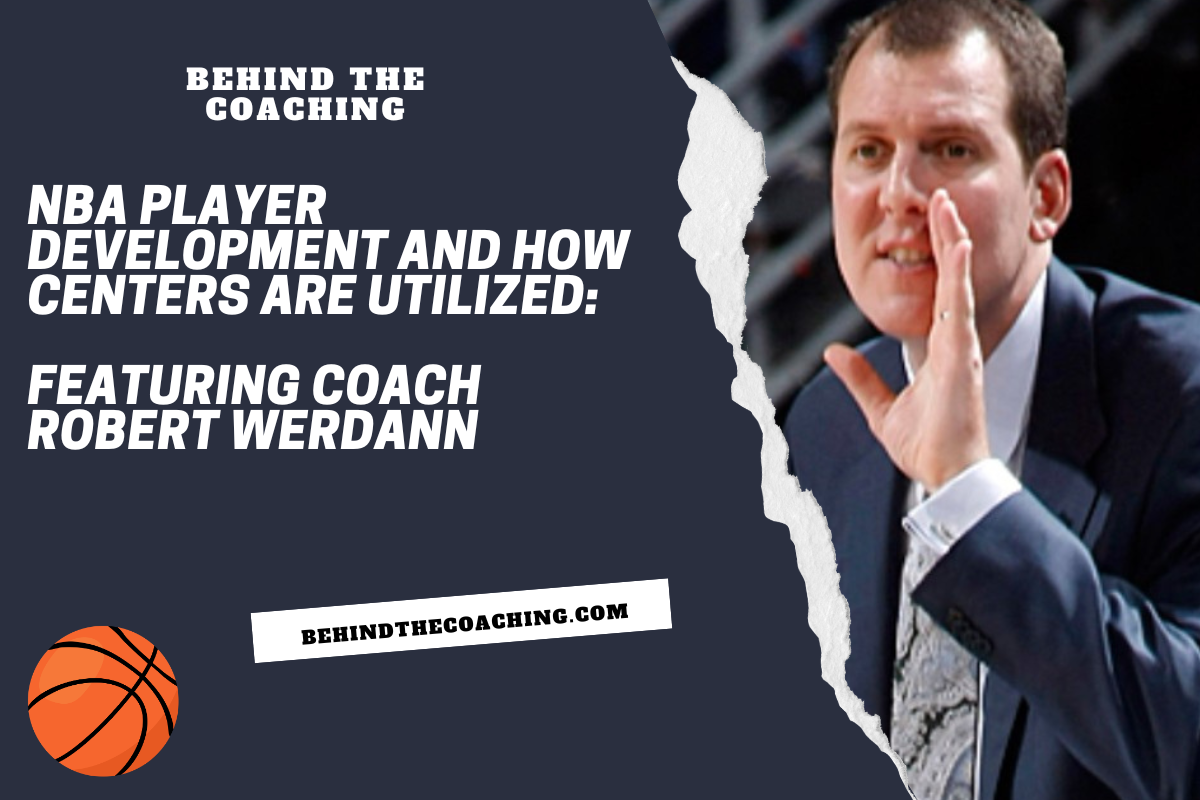
Growing up in Queens, New York, Robert Werdann was a force at the center position for the legendary Archbishop Molloy High School, earning McDonald’s All-American honors in 1988. He took his talents to St. John’s University, playing under future Hall of Famer Lou Carnesecca. Standing 6’11”, Werdann anchored the Red Storm defense, winning the 1989 NIT Championship and graduating in 1992 as the program’s all-time blocks leader (188). Werdann’s record of 188 career blocks stood for over 21 seasons until Chris Obekpa officially passed him on December 31, 2013, during a game against Xavier.
After an 8-year playing career that spanned the NBA (Denver Nuggets and New Jersey Nets), CBA, and international leagues, Werdann transitioned to the sidelines. He has served as an NBA Assistant Coach for the New Orleans Hornets, Golden State Warriors and the Charlotte Bobcats, a G-League Coach, and an Personnel and Advanced scout for multiple NBA franchises.
We talked with Coach Werdann to discuss player development, the evolution of the modern big man, and the grind of the NBA G-League.
You played for a legendary coach, the late Lou Carnesecca and left St. John’s as the all-time blocks leader. Looking back, what had the most lasting impact on your approach to the game as you progressed in your playing career?
RW: I was truly privileged to have played professional basketball at various levels. Getting cut after my rookie season taught me a valuable lesson in resilience, as I made it back to the NBA a few years later. Throughout my four years at St. John’s, Coach Carnesecca was the ultimate father figure, preparing all of his players for “what’s next.” If one was lucky enough to forge a career out of the game, great! For those who didn’t, you were surely pointed in the right direction to have a fruitful life. For me, having experience playing in the NBA, the CBA, the USBL, and South America really rounded out my basketball knowledge across different levels of play.
In the 1992 NBA Draft, Werdann was selected 46th overall by the Denver Nuggets under Dan Issel. Following stints in the USBL and CBA, alongside two returns to the NBA with the New Jersey Nets, he retired from playing in 2000. Werdann then transitioned to coaching, spending three seasons as an assistant under former NBA All-Star Jeff Malone for the Columbus Riverdragons in the early days of the National Basketball Development League (now the G-League).
Speaking of the G-League, the environment is unique, the rosters are younger, more prospect-oriented, and some players are often playing for their next contract rather than just the team win. How did you balance developing an individual’s skills while still instilling a team-first culture?
RW: I absolutely loved my time in the G-League. Realistically, most of those players are playing for their “first” contract. While there, I was fortunate to be around hungry players. There were very few distractions outside of “the work”. It was very pure: nobody was making very much money, so if you weren’t there for the love of the game and to improve, you didn’t last long. There was, and always will be, a lot of talent in the G-League; however, there are so few roster spots in the NBA. Many of the players hone their skills in the G-League, then move on to lucrative contracts overseas. In essence, the G-League is a proving ground not only for players but also for coaches, scouts, and front-office personnel. Team-first culture, although desirable, must take a back seat to personal development.
Following five seasons as an advanced scout for the New Orleans Hornets under Byron Scott, Werdann was promoted to assistant coach for the 2009-2010 season. He later joined Keith Smart’s staff at Golden State, sharing the bench with notable minds like Lloyd Pierce and Stephen Silas, before working under the late Paul Silas for the Charlotte Bobcats.
Whether it was on those Bobcats teams or throughout your entire career, did any specific players stand out from the rest in terms of their work ethic and development?
RW: One player stands out more than the rest. I got to spend a lot of time with Bismack Biyombo while with the Bobcats. He had a relentless work ethic as a rookie in the league. Every day off that season, he wanted to be in the gym. I was then fortunate to cover a playoff series while he was with the Raptors, and his performance in that series earned him a huge contract. I was overjoyed for him.
Editor’s Note on Biyombo’s Work Ethic:
During the 2016 NBA Playoffs. Stepping up for the Toronto Raptors, Bismack Biyombo put on a defensive masterclass, including a franchise record 26-rebound performance against LeBron James and the Cleveland Cavaliers in the Eastern Conference Finals. This directly translated into him earning a four-year, $72 million contract with the Orlando Magic that summer.
From a coaching standpoint, how has the way you teach rim protection changed? Since bigs are now pulled out to the perimeter so often, does a ‘pure’ rim protector have to be more mobile today than when you were playing, or can the same interior fundamentals apply today?
RW: The same interior fundamentals will never change. Everyone needs to learn how to rotate to help. Coach Carnesecca did a fantastic job of making sure his players got to their spots on defense. I was lucky to be tall, so when I got there, I could block shots. However, getting to spots, altering shots with two high hands, or drawing a charge are equally valuable. Sure, mobility in this day and age is very important, but anticipation and defensive IQ, play a major role in a sound defense.
How would you describe your coaching philosophy? Do you focus on interior toughness, or have you adapted to a more perimeter-oriented style?
RW: My Coaching Philosophy is very simple. I was lucky enough to go to the summer- league with the New York Knicks a long time ago. Jeff Van Gundy’s teaching style and words resonated with me, and I subscribed to his philosophy moving forward. He said: “Defend and Share the Ball.” I took it and ran with it every stop I made as both a player and a coach. When you commit to defending, you create easy scoring opportunities for yourselves. When you commit to sharing the ball, you keep defenses on their heels.
Before becoming a full-time coach, you spent significant time as a scout. Those instincts never really leave you, how did that ‘scout’s eye’ help you when it comes to breaking down an opponent’s tendencies or helping a young player realize their own potential?
RW: I had the opportunity to be both an Advance Scout and a Personnel Scout later in my career. I loved both positions equally. Advance Scouting is more on the coaching side, while Personnel Scouting lets you dig deep into players’ abilities and forecast their potential. While experience in both can provide a leg up in breaking down opponents’ tendencies, identifying talent and helping a player make strides towards reaching his potential might be one of the most rewarding aspects of the game.
Since his time in Charlotte, Werdann has continued evaluating talent at the highest levels, serving as a scout for multiple NBA franchises, head coach of the Grand Rapids Drive (Denver Nuggets G-League affiliate), and guiding youth development through travel basketball.
Blending your scouting and coaching background, what advice would you give coaches about evaluating their own roster? How do you stay objective about a player’s ceiling when you are working with them every single day?
RW: One tool I always found helpful in evaluating my roster is a grading sheet. We used it in the NBA, and not only does it work at every level, but it also provides the necessary context to measure improvement both year to year and season to season. I would pick 10 skills/abilities, then rate them 1-10 to evaluate where the player currently is. As the season progresses and the player improves, the rating reflects that improvement. We would do it 4-5 times per season, and every coach on staff would have to contribute their opinions. What a tool!
Behind the Coaching extends a massive thank you to Coach Robert Werdann for taking time out of his schedule to share his story, insights, and lifelong contributions to the game of basketball through playing, coaching, and scouting.

Hey! I’m Joe, the Founder & Managing Editor of Behind the Coaching. I primarily write about Basketball, but I oversee the editorial for all sports on our website. Hope you have a great time here!