
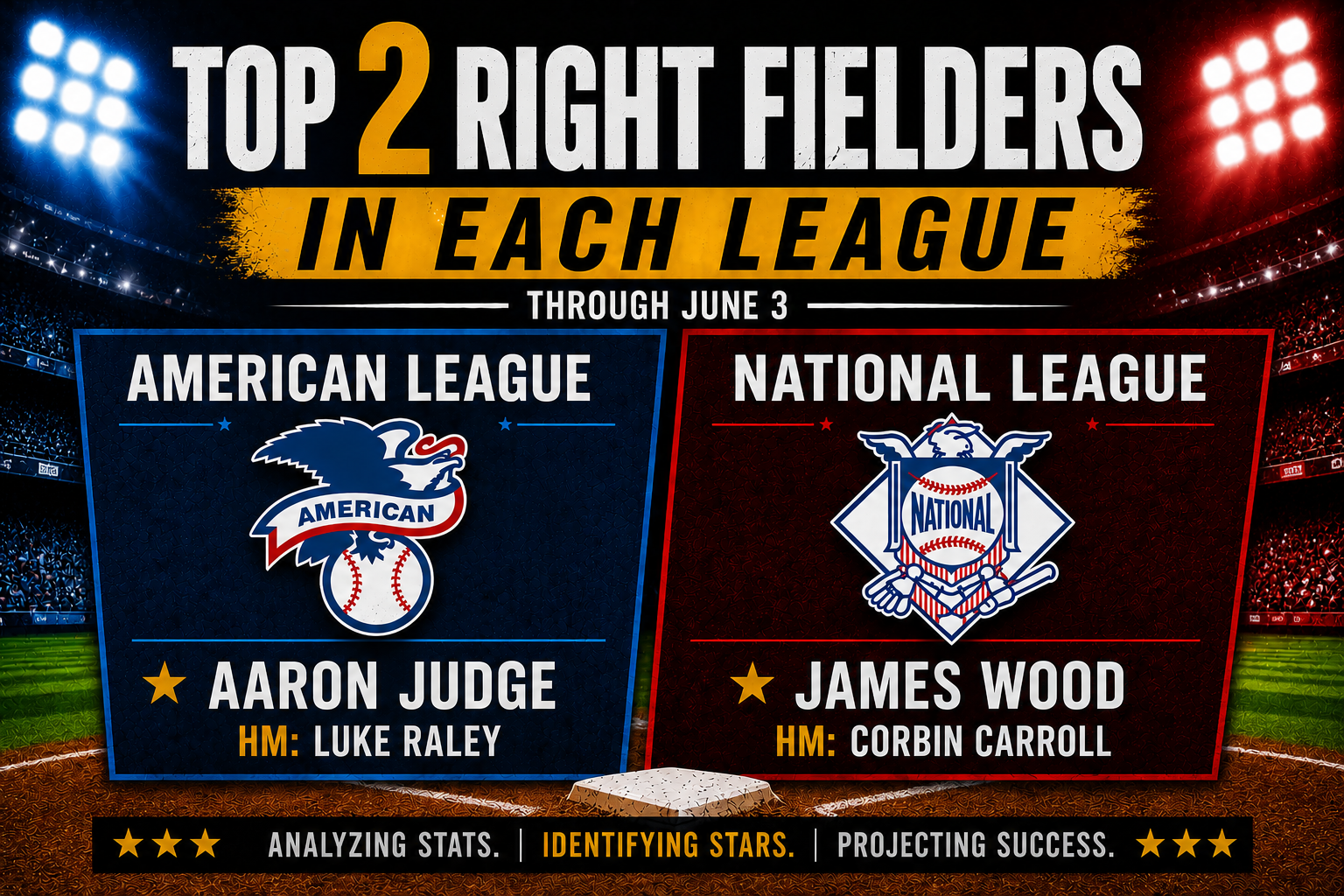
| American League | National League |
| Aaron Judge | James Wood |
| HM – Luke Raley | HM – Corbin Carroll |
For these right field rankings, I placed a greater emphasis on offensive production than defensive value due to the current landscape of the position. Metrics such as WAR, wRC+, OPS, batting average, on-base percentage, slugging percentage, and weighted runs above average (wRAA) were used to evaluate offensive impact, while advanced metrics like xwOBA, xSLG, barrel rate, hard-hit rate, and walk rate helped determine sustainability. Defensive value was considered, but offensive consistency and long-term projections played a larger role in separating the top candidates. All statistics are from FanGraphs and Baseball Savant and are current through June 3.
I’ll preface this with saying, these stats will mostly reflect offensive stats, because there’s only 5 qualified right fielders who have a positive defensive rating (according to FanGraphs). Corbin Carroll, our honorable mention for the National League is at a -.3, which is 7th best, but right field is mainly becoming a power position and a hitting focused position, so I’m focusing on the hitting stats for this one.
Carroll and James Wood are very similar players, in the fact that they’re really good at specific things. Carroll is speedy, his range in the outfield is almost unparalleled (besides Pete Crow Armstrong), while James Wood’s bat speed, barrel rate, and hard hit rate are in the 100th percentile. Literally, he’s the best at specific things. Wood holds a slight edge in batting value, while Carroll gets the nod in baserunning and defensive value. The reason I’m choosing Wood over Carroll in this instance is because of sustainability. Wood’s xwOBA is in the 100th percentile, same with hard hit rate, barrel rate, and xSLG. He isn’t going to just fall off the rest of the season. He also has a keen ability to draw walks. He’s in the 98th percentile compared to Carroll’s 79th. Carroll is seeing an increase in weakly hit balls and topped balls, which isn’t showing promise. Eventually the weak hits won’t find holes, the topped balls will become outs. The concerning thing for me with Carroll is that while his slash line is good (.291/.382/.546), he is hitting 7% less balls in the air. If that trend continues, we’re going to see a drop in power and extra base hits. Wood has the better slash line as well, (.292/.433/.609) which I think is more sustainable with his barrel rate and fly ball rate. While Carroll leads in WAR with a 2.6, Wood only trails with a 2.5, and Wood has a wRC+ of 185 compared to Carroll’s 156. Both are elite, but I’m giving the nod to Wood.
Aaron Judge shouldn’t be a surprise here. He’s by far the best right fielder in the American league right now, and I don’t mean defensively, I mean offensively. 2.3 WAR, wRC+ that only trails Luke Raley (AL honorable mention), and a slash line of .291/.359/.550. Raley isn’t far behind. His wRC+ is second in MLB right fielders only behind James Wood. Raley has a 1.4 WAR in 10 less games than Judge, and has a slash line of .301/.363/.624. The more I write this the more I consider making Raley my All-Star and Judge the honorable mention.
I can’t though. Judge is second in wRAA, while Raley is at fifth. Judge walks a lot more than Raley, 12% more in fact. What it comes down to is sustainability, again. Judge has more barrels this season and a higher solid hit rate. His ability to hit any pitch at a positive rate (besides the slurve and slider) are what sets him apart from Raley, who has a negative value rating against the following pitches (slider, sinker, split-finger, and slurve). More pitches to get Raley out on. Less pitches to get Judge out on.

Ian M. Ryan is a journalist from Oak Forest, Illinois. He follows high school, college, and professional sports.