75 Years of Legacy: Interviewing Former Army Hockey Coach Brian Riley
The Army West Point hockey program has seen many changes in the past year as the landscape of college athletics evolves, but the most profound change came at the end of this past season. This 25-26 season is the first season Army Hockey hasn’t been head coached by a member of the Riley family in 75 years. The family line came to an end last spring with 21-year head coach, Brian Riley, announcing his retirement at the end of the season. I was fortunate to have the opportunity to interview Coach Riley this past Thursday, getting a chance to gain his perspective on Army Hockey, his family legacy, and his most meaningful moments with the program.
One Word: Family
Coach Riley wasn’t the first of his family to leave their mark at West Point; his dad set the path for the family, coaching from 1950-1986, followed by Coach Riley’s brother, Rob, from 1986-2004, leading to Brian Riley to continue the family business for 21 years. Notably, Brian Riley’s dad, Jack, was head coach of the 1960 US Olympic hockey team— the first team to win a gold medal for our nation. Being 3rd in their lineage, Coach Riley had big shoes to fill, but he added a different perspective to this coaching opportunity, which showed the honor in having the job.
“I never imagined that I would ever get the opportunity, or have the opportunity to be the head coach of the army hockey team. Not in my wildest dreams”
Coach didn’t feel pressured, but more so honored, to have been appointed the job that his family had run for generations. Coach Riley laughed when I asked about pressure, joking that his brother Rob had it all, being the immediate successor to his Dad, Jack, who is ingrained not only in Army Hockey, but also, hockey in all of the United States. As we discussed his family legacy further, he continued to bring up the fact that coaching at West Point wasn’t pressure to fill family shoes, but an opportunity of a lifetime.
“Just having the opportunity to coach at the place where we knew how much we all respected West Point and everything that it stood for… right up until the last day I was coaching, honestly, I had to pinch myself knowing that I was head coach of the Army hockey team”
To me, this was remarkable to hear from someone who had such high expectations coming from the Riley family. The sense of dignity this role provided him with displays not just the personal character of Coach Riley, but the overall build of the Army Hockey program. Throughout our interview, he maintained the idea of “the power of one”, an idea his dad taught him before he started coaching. It was clear that before he became head coach, his family had built a culture at West Point that was truly “the power of one”, and Coach Riley summed that up as:
“If there’s one word that sums up Army hockey, it’s family”
The Future of our Nation
One of the key components that sets West Point athletics apart from other collegiate programs is the military obligation. Throughout their 4-years at West Point, students, or cadets, go through extensive academic and military requirements to continue their time at the institution. For athletes, this standard remains the same, despite a challenging athletic schedule on top of their normal duties. I asked Coach Riley about what he did as head coach to help cadet-athletes succeed in school, in the Army, and on ice, to which he made sure everyone understood the focus.
“You have to understand, in my case, the military academy wasn’t part of the hockey program, the hockey program was part of West Point”
It was clear he understood that the mission of the academy, though still important, wasn’t to win hockey games, but to develop the future leaders of our nation’s military. Throughout his time at West Point, he strived to put the academy mission first, ensuring his men were able to lead our nation in case of conflict. He mentioned later:
“At West Point, I think you’re more than just a coach of hockey- you’re a coach in the game of life”
It was clear Coach Riley made sure to inspire his men to be more than hockey players, but to be leaders. Brian Riley, though now retired, is continuing to make an impact, speaking for companies, teams, and organizations through Gold Medal Leadership. His organization gives leadership lectures, using examples from his time coaching, as well as examples from former players who now lead our country in battle. Riley’s focus is a lesson his dad taught him before he started coaching, which was “the power of one”. This lesson made a profound impact on his coaching career, and he continues to use it to this day to inspire leaders in all walks of life.
“He said, Bri, you make sure you always show your players that you care for them more as people than you do as hockey players, and if you do that you will create the power of one”
This lesson gave him insight for how to be successful, and it was clear that his players felt cared for and loved for the duration of his time as head coach. Though it was apparent throughout his whole career that his players felt united by Coach Riley, it was never more evident than in the historic rivalry games.
One Family, One Battlefield
Army West Point hockey has 2 main rivalries, but one is much different than in the other sports at the academy. Only 2 of the 3 major service academies sponsor a division 1 hockey team, with the naval academy being the odd one out. Army still plays Air Force every year, and for the 2nd rival, it goes much deeper than just service academies: 2 nations. Yearly, the Army West Point hockey team squares off with the Royal Military College Paladins, the Canadian military academy hockey team, in what is one of the most special rivalries in college hockey.
These two rivalry games are tough, as both of them dig much deeper than just hockey, but a long line of friendship and history. I asked Coach Riley about the meaning of these games, to the school and the sport, and he was extremely grateful to be a part of these contests.
“…and I always tell people, Army-Air Force, to me, that’s the most meaningful rivalry in all of college hockey”
College hockey has deep, historic rivalries, but nothing means more than 2 of our nation’s service academies battling it out, dueling against each other for just 2 days, and reuniting as one team.
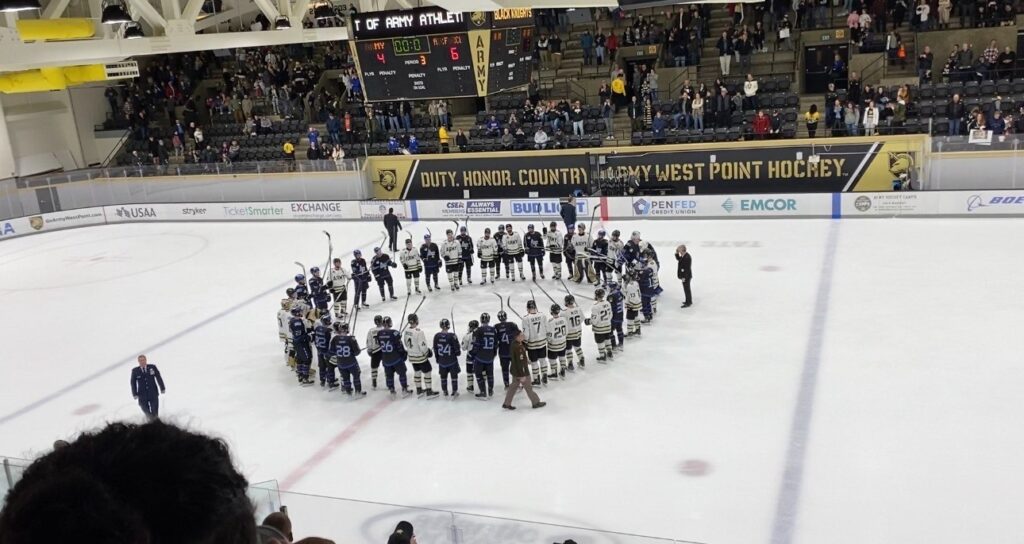
“I don’t think there’s another rivalry in college hockey where after the series, you have 2 teams get around center ice, shoulder to shoulder, and salute the fans”
These games were always special, as is any academy matchup, but Army vs RMC held a special meaning to Coach Riley. This rivalry dates back to when his dad started coaching at Army. Not only is this a long standing rivalry, but in the game of hockey, USA vs Canada is always going to be a fight.
“You know, you have US versus Canada in any type of hockey game, it’s going to be an intense rivalry”
Coach Riley was proud to talk about being a part of these longstanding traditions, but they would be even more meaningful in his final season in 2025. Both opponents would honor Coach prior to the games, as a sign of respect for the legacy he and his family had left at Army and in their rivalry games. Importantly, in his final season, his Black Knights would go 5-0 against their two rivals, completing the clean sweep over Air Force in Colorado in the shootout. Coach Riley finished his career in storybook fashion, on top of their biggest rivals.
The Last Dance
I ended my conversation with Coach Riley prompting him to reflect on his tenure at West Point, asking for his favorite memory out of a long list of great moments. Fittingly, he said his favorite was his final game at West Point against American International College, on Coach Riley appreciation night. This regular season game was more than just Coach Riley’s last game at West Point, but as he stated:
“The last game played at West Point was a culmination of 75 years of Riley’s being head coaches”
Tate Rink was sold out, and with the Black Knights wearing throwback uniforms from the 2004 season, which was Coach Riley’s first year at the helm. AIC jumped out fast, but late in the third, Army took a 2-1 lead, just needing to hang on to end a historic career on a high note. Then, with their goalie pulled, AIC netted the game tying goal, sending it to overtime. That’s when Army forward Vincent Salice called game. In Coach Riley’s words:
“Vinny Salice made an unbelievable play in overtime, beat a defenseman, got a shot off, went top shelf, and the roof just came off the place”
Viewers at Tate Rink were all standing, cheering loud for Coach Riley’s final game. The Alma Mater played, he was given a chance to speak, and the whole place remained on their feet. Till the end, the Army faithful showed a profound display of gratitude and respect, as Coach Riley soaked in the views for the final time.
Legacy
Coach Riley left his mark on a program of great tradition and legacy. He followed his family line, a tradition that had been at Army for 75 years, leading with dignity and respect. His tenure saw success on ice, but his impact was seen in the type of men he helped form into leaders of character. He continued a culture that was set in foundation 50 years prior, leaving a tremendous mark on a program of our future service members. Through all of the ups and downs, he remained a role model to all of college hockey and continues to make an impact throughout the world in retirement. The power of one was more than just a slogan, and as he said:
“I love all the guys that I had the opportunity to coach”